
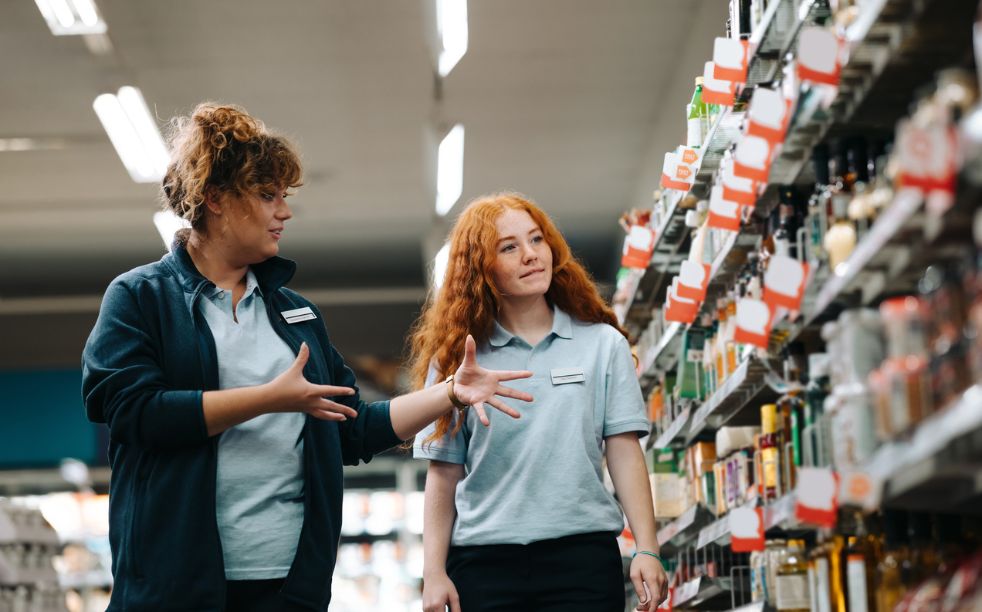
If you’ve ever worked a Saturday shift stacking shelves or done a stint on the checkout over Christmas, you already know retail isn’t just one job. It’s dozens of them, stacked on top of each other in the same store. This article breaks down the main types of retail jobs in Australia, what they actually pay, and how to land your first one.
Why retail is worth a look
Retail is the second largest employing industry in the country, employing over 1.3 million people. It kept growing over the past year too, and earlier in 2026 the Bureau of Statistics reported retail as one of the industries leading a fresh rise in job vacancies, alongside construction and hospitality. So while some industries are tightening up, retail is still hiring.
It’s also one of the few industries genuinely built around part-time and flexible work. Around half of all retail employees work part-time hours, which makes it a realistic option if you’re studying, easing back into work after time off, or just want your foot in the door before figuring out what’s next.
We see a version of this in our own research. Our 2026 Youth Employment Report found young jobseekers are 1.3 times more likely to be unemployed than the general adult population, and 1.5 times more likely to be underemployed, mostly because they get stuck trying to find that first employer willing to take a chance on them. Retail is one of the few industries still genuinely open to first-timers, which is worth keeping in mind if you’re just starting out.
The jobs you’ll see on the shop floor
These are the roles most people think of first, and they’re usually the easiest to get without any experience behind you.
Sales assistant is the single largest occupation in Australian retail, and it’s a broad title. Depending on the store you could be folding clothes, helping someone choose a phone plan, or restocking shelves between customers. Checkout operators and cashiers handle transactions, returns and payments, mostly in supermarkets and department stores. Customer service roles cover enquiries, complaints, click and collect, and returns, either out on the floor or at a service desk. In fashion, electronics and telco stores you’ll also see retail sales consultant roles, which lean more on product knowledge and upselling than the general sales assistant title.
The jobs that happen behind the scenes
Not everyone wants to be front of house, and retail has plenty of roles that keep you off the floor.
Shelf fillers keep stock rotated and presented properly, and it’s one of the biggest occupations in the industry, bigger than most people realise. Storepersons receive deliveries, manage the stockroom, and prepare online orders for dispatch. If you’re the type who likes things counted and in order, stock control roles involve tracking inventory levels and flagging discrepancies. Larger retailers with their own warehousing also hire warehouse assistants to pick and pack orders.
The jobs that need a bit more specialty
Some corners of retail want specific product knowledge, and the pay usually reflects that.
Pharmacy assistants support pharmacists with over-the-counter sales and customer queries. Supermarkets employ butchers, bakers and deli attendants, which are trade-based roles in their own right. Visual merchandisers design window and in-store displays, mostly in fashion and department stores. And purchasing or supply logistics clerks work with suppliers and buyers on stock ordering, which can be a decent stepping stone toward a buying career later on.
The jobs with a bit more responsibility
Retail also has a genuine, well-worn ladder if you want to build a longer career out of it. Most retail supervisors and team leaders started out on the floor, running shifts and coordinating rosters before stepping up. From there it’s assistant store manager, then store manager, with full accountability for sales, staffing and budgets. A smaller number go on to area or regional manager roles overseeing several stores at once, usually after a few years managing one.
Which part of retail suits you
Retail isn’t really one industry, it’s several sitting under the same label, and each has its own rhythm. Supermarkets and grocery stores are the biggest single sector and tend to offer the steadiest, most consistent hours year-round. Pharmacy and other store-based retailing is the second biggest, and suits people who like repeat customers and product knowledge. Fashion and footwear retail is more seasonal, with your busiest stretches around EOFY and Christmas. If you’d rather be hands-on, hardware and garden retailing tends to suit people who like knowing a specific range inside out, and if you’re mechanically minded there’s also motor vehicle and parts retailing, a smaller but stable sector.
What retail actually pays
Median weekly earnings across retail sit at $1,334, lower than the $1,700 median across all industries. That’s mostly because so many retail jobs are part-time or entry-level by design, not because the industry pays badly. Pay climbs fairly quickly with responsibility. Supervisors and department managers usually sit well above the industry median, and store managers running a full team and budget are paid accordingly. The upside of retail is that you can walk in with zero experience and, within a few years, be running a team without ever needing a formal qualification to get there.
What you actually need to get started
Most entry-level retail jobs don’t ask for any qualifications. What they’re actually looking for is reliability, someone who’ll turn up on time, every shift. Beyond that, you want to be comfortable talking to strangers (including the occasional difficult one), reasonably confident with numbers for handling transactions, and okay being on your feet for most of a shift. Availability across evenings and weekends helps a lot too, since that’s when most stores are busiest.
If you’re looking at liquor retail, a Responsible Service of Alcohol certificate will help. A White Card is worth having if you’re aiming for hardware or trade-focused stores. Outside of that, most of the training happens on the job.
The barrier nobody mentions
Something that doesn’t come up much in these kinds of articles is transport, and it’s a bigger issue than people expect. Retail shifts often start early, run late, or fall on weekends when public transport is less frequent, and a lot of stores are in shopping centres that aren’t well served by buses or trains. Our Getting to Work Report, based on surveys of both jobseekers and employers, found transport access genuinely affects whether people can take on and keep shift-based work like retail, not just an inconvenience around the edges. If transport is likely to be an issue for you, it’s worth raising with your employment services provider early rather than after you’ve already missed a few shifts.
Getting your foot in the door
Applying in person still works in retail, more than people expect. Store managers are busy, and they’ll often remember the person who walked in and asked for a chat over the one who only sent an email. Keep your resume to one page and put your availability near the top, not buried at the bottom. It’s worth knowing a bit about the store before you apply too, mentioning their range or a recent promotion shows more initiative than a generic application. Be flexible on hours where you can, especially early on, since availability is often what decides between two similar candidates. And don’t rule out a casual or part-time role as a starting point. Plenty of store managers started on the checkout.
If you’re looking for your first retail role, or you’re ready to move from the floor into a leadership position, our job seeker services can help match you with local retail employers and support you through the process.
AKG offers an Introduction to Retail short course through our training organisation, MAX Solutions. You’ll gain the skills to interact and communicate with a diverse range of customers, assist with basic enquiries and contribute to a service culture. This is the perfect way to boost your retail knowledge and help your resume to stand out with retail managers.
References
Australian Bureau of Statistics. (2026). Job vacancies increase in February 2026. https://www.abs.gov.au/media-centre/media-releases/job-vacancies-increase-february-2026
Jobs and Skills Australia. (2025). Retail Trade — Occupation and industry profiles. Australian Government. https://www.jobsandskills.gov.au/data/occupation-and-industry-profiles/industries/retail-trade
AKG Australia. (2026). First Job to Future Career Report (AKG 2026 Youth Employment Report). https://akg.com.au/wp-content/uploads/2026/05/AKG-First-Job-to-Future-Career-Report.pdf
AKG Australia. (2024). Getting to Work Report. https://akg.com.au/wp-content/uploads/2025/06/Getting-to-Work-Report-MAX.pdf.coredownload.pdf